
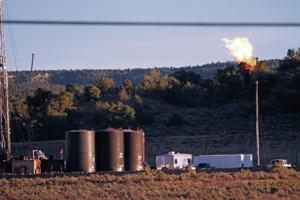
 An oil and gas wellhead flares in the Chaco Canyon area in October 2014. Luis Sánchez Saturno/New Mexican file photo
Posted: Friday, January 27, 2017 11:50 pm | Updated: 11:50 pm, Fri Jan 27, 2017.
A group of congressional Republicans is attempting to nullify a federal rule that requires oil and gas producers to significantly limit methane pollution on federal and tribal land, a move strongly opposed by New Mexico’s Democratic lawmakers and environmental groups.
Supporters of the action say overturning the methane rule would protect the oil and gas industry in New Mexico and its crucial contribution to the state’s financial future. But those who believe the methane rule should remain in place say no other state would be more at risk of losing environmental protections than New Mexico if the regulation were rolled back.
Also at stake are potential royalties to state coffers from methane lost to the atmosphere, they say.
Republicans in the U.S. House of Representatives will vote next week on whether to invalidate the Bureau of Land Management’s methane rule entirely through the Congressional Review Act. If successful, the action would bar the U.S. Interior Department from developing any regulations with “substantial similarity” to the rule in the future.
The congressmen also are seeking to repeal the Department of the Interior’s Stream Protection Rule, which prevents coal mining operations from polluting nearby water bodies.
“We believe there is no alternative other than to rescind the rule,” U.S. Rep. Rob Bishop, R-Utah, chairman of the House Committee on Natural Resources, said in a teleconference Friday.
The action is in line with promises made by the Trump administration, which has pledged to roll back a number of environmental regulations as part of President Donald Trump’s America First Energy Plan. These regulations include former President Barack Obama’s Climate Action Plan and a moratorium on coal mining on federal land, as well as the regulations on methane pollution.
In the first week of his administration, Trump ordered a freeze on all grants and contracts issued by the Environmental Protection Agency and signed a memorandum encouraging agencies to move forward with the Dakota Access Pipeline, a project that sparked massive protest over fears the pipeline could harm water critical to Native communities.
The Trump administration’s hiring freeze on federal agencies also raises questions about how the BLM will keep up with increased permitting of oil and gas leases — which the administration has pledged to expand — while ensuring rigs are functioning safely.
On Wednesday, the bureau leased 843 acres of drilling rights in the Chaco Canyon region for close to $3 million, a sale that had been postponed three times since 2012 amid community protest.
Donna Hummel, a spokeswoman with the BLM in New Mexico, said the department “has one of the busiest oil and gas programs in the bureau. The program has a high staff turnover rate, which can lead to regular vacancies.”
In November, the Obama administration finalized the BLM’s Methane and Waste Prevention Rule, which requires oil and gas producers operating on federal and tribal land to fit wells with methane-capture technology, to stop flaring natural gas and to monitor wells to prevent them from leaking methane into the atmosphere.
The Environmental Protection Agency also issued regulations meant to curb methane released from existing oil and gas wells.
Methane, the main component in natural gas, is odorless and transparent, but it is the most potent greenhouse gas for the first 20 years after it is released, making it a key contributor to a warming climate.
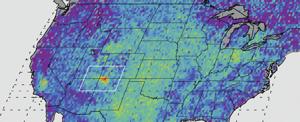
The Four Corners region in northwestern New Mexico has the largest concentration of atmospheric methane in the nation, with a cloud roughly the size of Delaware hovering over the area. A 2016 study by NASA and the National Oceanic and Atmospheric Administration determined the pollution was largely the result of the production and distribution of oil and natural gas in the region, one of the highest-producing areas in the nation.
A number of Western states filed a lawsuit opposing the BLM’s methane rule immediately after it was finalized. But New Mexico Attorney General Hector Balderas joined California’s attorney general last month in filing a motion to intervene in the lawsuit on behalf of the federal government.
Bishop and others on Friday’s conference call said the methane capture rule creates prohibitive costs to an industry already struggling with low prices, forcing companies to lay off well-paid workers and requiring technology averaging $50,000 per rig to be implemented on low-producing wells. The rule constitutes federal overreach and is unnecessary, they say, because states and companies are already effectively self-regulating.
Carla Sonntag, president of the New Mexico Business Coalition, said the rule is hurting the state.
“We understand low market prices [for oil and gas] are part of the equation,” she said. “But the rule has been unnecessarily punitive.”
New Mexico lawmakers have had to resolve significant budget deficits — estimated at some $600 million at one point in the fall for the current and last fiscal years combined. Because the state relies largely on revenues from oil and gas operations, Sonntag said, the state can’t withstand any additional strain on the industry.
But others say the state is losing millions of dollars because it is not collecting royalties on the methane released through venting and flaring.
“No state has more to lose from a rollback of this rule than New Mexico,” said Jon Goldstein, senior energy policy manager for the Environmental Defense Fund.
New Mexico accounts for one-third of all natural gas waste in the U.S., estimated at over $100 million in 2013, Goldstein said.
Democratic U.S. Sens. Tom Udall and Martin Heinrich of New Mexico urged their colleagues in Congress to oppose House Republicans’ efforts to end the BLM rule in a letter last week.
“Using the Congressional Review Act to repeal this Rule would be an exceedingly blunt tool that would harm federal taxpayers and western states’ budgets,” the senators said.
It would lead to the loss of millions of dollars, “slowing the growth of small businesses rising to meet this challenge, all while polluting our air,” they said.
Ryan Alexander, president of Taxpayers for Common Sense, said years of cost-benefit analysis by the BLM found the financial benefits of the rule outweigh regulatory costs, with net benefits between $50 million and $200 million annually.
She said the Trump administration and Congress could work to change elements of the rule, but that employing the Congressional Review Act is overkill.
“The rule [BLM officials] are updating is 36 years old, and there have been millions lost,” she said. “There is no need to tie the hands of the administration to solve a problem that is so well documented … that needs to be solved.”

Leave A Comment