
Asha Davis, 9, a member of the student organization Global Warming Express, addresses the crowd Friday during the unveiling of a new solar array at Acequia Madre Elementary School. The project is part of an ongoing energy conservation initiative at Santa Fe Public Schools. Work is set to begin next month on two solar arrays, one at Santa Fe High School and another at Ramirez Thomas Elementary. Luis Sánchez Saturno/The New Mexican
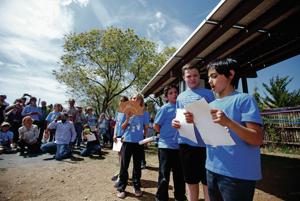

The 80 solar panels, installed by Positive Energy on a playground shade structure, are the culmination of an effort by the student organization Global Warming Express. The panels will supply 40 percent of the school’s power and make Acequia Madre the 10th public school in the city to integrate solar into its energy mix.
As part of an ongoing energy conservation initiative, Santa Fe Public Schools is working toward a goal of carbon neutrality at its facilities by cutting energy and water use, food waste and utility bills, with the hopes of siphoning the savings back into classrooms.
The school board on Tuesday approved a 1-megawatt solar power project, funded by a $2.96 million Clean Energy Revenue Bond from the New Mexico Finance Authority. The state bond program is aimed at projects that would help reduce utility costs for state agencies and public schools.
The majority of the bond issued this week will fund a $2.6 million project at Santa Fe High School, where 90 kilowatts of solar power will be installed to supply about 65 percent of the school’s electricity. The remaining funds will be used to install 117 kilowatts of solar power at Ramirez Thomas Elementary School.
Construction for both projects is set to begin in May, and the arrays are expected to be up and running by October.
In a statement announcing approval of the bonds, school board members said they were considering the long-term impact of the technology, saying that while the financial benefits were “minimal,” it “underscores our commitment as adults to the relevancy of our student’s world.”
“It is irresponsible to say that ‘we could’ but ‘we chose not to,’ ” the statement said.
Since the district’s conservation initiative began during the 2010-11 school year, Santa Fe schools have reduced their reliance on natural gas by 24 percent and have produced more than 616,700 kilowatt-hours of solar power, according to information provided by the district. Water use is down by more than 40 percent, and 14 schools have implemented food composting programs.
“We really work hard to be responsible and have a vision that is one our kids will support,” said Carl Gruenler, the district’s deputy superintendent of business operations. The district’s goal is to help kids “embrace their world, rather than fear it,” he said.
The district is currently looking to close a $2.9 million budget deficit within the next month and has proposed special education cuts to help fill the gap.
The solar installation project at Acequia Madre, however, was funded through more than $130,000 in state capital outlay funds in a bill sponsored by state Sen. Peter Wirth and Rep. Brian Egolf, both Democrats, and signed into law by Gov. Susana Martinez in 2015. Additional capital outlay funds were used for a solar project at Atalaya Elementary School.
“I’d love to see a stimulus effort using this type of capital dollars to really push the construction of solar on school buildings, state buildings, local buildings,” Wirth said following the ribbon-cutting ceremony at Acequia Madre. He said he also hopes to see a community solar bill pass that would help low-income residents install solar power. He has proposed such a measure, but it has yet to make it out of the Senate Conservation Committee, he said.
At the ceremony Friday, Matt Miller, a representative for the office of U.S. Sen. Tom Udall, D-N.M., praised the children involved with Global Warming Express for making strides where adults struggled to make progress.
“Your tenacity in getting these solar panels up is a huge inspiration to the senator,” he told the students. “It shows that anyone, regardless of size or age or gender, can bring positive change to this community and the country.”
Udall joined 147 other lawmakers in expressing support for President Barack Obama, who signed an agreement in Paris on Friday pledging to reduce greenhouse gas emissions, alongside the leaders of about 175 other countries.
“People think kids are too little to solve big problems, but we can,” said Asha Davis, one of 12 members of the Global Warming Express who were at the event Friday. The student-run organization, focused on solving climate change, had petitioned the community and politicians to bring solar panels to their school.
The group, founded three years ago at Acequia Madre and now present in seven other Santa Fe schools, won the Governor’s Award for Environmental Youth Leadership on Friday morning.
Rowan Jansens, 13, a seventh-grader at the Mandela International Magnet School, returned to Acequia Madre to celebrate the project, which he had helped to pioneer when he was in fourth grade there.
“If more students are working, then more solar arrays like this will be built, hopefully,” he said.
Jansens recalled that one of the hurdles his group had to jump through was community approval. Acequia Madre Elementary is within Santa Fe’s historic east-side district, and getting solar approved for the school meant working closely with the community on ways to integrate solar power at the campus while preserving the neighborhood’s cultural legacy.”
“In the beginning, it was hard because of all the cultural elements,” Jansens said. “As time progresses, hopefully solar panels will be seen as a benefit and not just an ugly structure. And they will see the beauty in the structure, not just why it’s there.”
Contact Rebecca Moss at 505-986-3011 or rmoss@sfnewmexican.com.

Leave A Comment